
Part two of a three part series on nonlinear dynamical systems, self regulation and NeurOptimal neurofeedback. Part one is Why Your Brain Is Not a Thermostat.
Research suggests the brain’s dynamics sit near a critical point between excessive order and disorder, a dynamical regime that maximizes its dynamic range and its ability to move flexibly between states. Anxiety, chronic stress and trauma are associated at a group level with reduced flexibility in these dynamics, which is one way of describing the experience of feeling stuck. Complex systems typically change through thresholds and well timed perturbations rather than through steady effort.
Part one of this series was about hearts, ferns, ant colonies and the surprising discovery that a perfectly regular heartbeat is bad news. This part is about the organ that has been reading all of it.
Here is where we left off. Living systems are nonlinear dynamical systems, meaning they are described not by fixed values but by how their state evolves over time, under rules where small inputs can have large effects and timing matters as much as force. They are organized across many scales at once. They regulate themselves through layers of feedback rather than through a controller. And their health shows up not as steadiness but as structured variability, the capacity to move through a wide range of states and come back.
The brain is the most extreme example of all of this that we know about. It is also where the argument gets interesting, because when a nervous system loses its range, the loss is not abstract. It feels like something. It feels like lying awake at 3am running the same twelve seconds of a conversation. It feels like a body that startles at the sound of a dropped pan and takes forty minutes to come back down. It feels, most commonly, like being stuck.
This article is about what stuck looks like in the language of dynamical systems, and about the more hopeful half of that same language: how complex systems change when they do change.
Neurons do not do proportional
Start small, with the unit.
A neuron is a profoundly nonlinear device. It gathers input from thousands of other neurons, and for most of that input it does approximately nothing. Charge accumulates. Nothing happens. Charge accumulates further. Still nothing. Then the membrane potential crosses a threshold and the neuron fires an action potential that is the same size every time, regardless of whether the threshold was crossed by a hair or by a mile.
This is the definition of nonlinear. There is no proportionality anywhere in it. A neuron is also, in the strict sense, a dynamical system in its own right: the state variable is the membrane potential, the rule is the set of equations describing ion flow across the membrane, and the spike is what that rule produces when the state crosses a threshold. Hodgkin and Huxley won a Nobel Prize for writing those equations down in 1952, and they remain one of the great successes of applying dynamical systems mathematics to biology. A neuron is essentially a small, decisive, all or nothing device with no interest in nuance, and there are roughly eighty six billion of them in your head, each connected to thousands of others.
Add two more features. After firing, a neuron enters a refractory period during which it cannot fire again, which puts a natural rhythm into the whole affair. And roughly twenty percent of cortical neurons are inhibitory, meaning their job is to make other neurons less likely to fire. The brain spends an enormous amount of its energy budget on not doing things. The balance between excitation and inhibition turns out to be one of the most important variables in the whole system, and we will come back to it.
So: billions of threshold devices, densely interconnected, some pushing and some restraining, all operating on a delay. If you set out to design a system capable of complex nonlinear dynamics, this is more or less what you would build.
In plain language: neurons fire all or nothing once a threshold is crossed, which makes them nonlinear from the ground up. Networks of them can do things no individual neuron can.
What a brain wave actually is
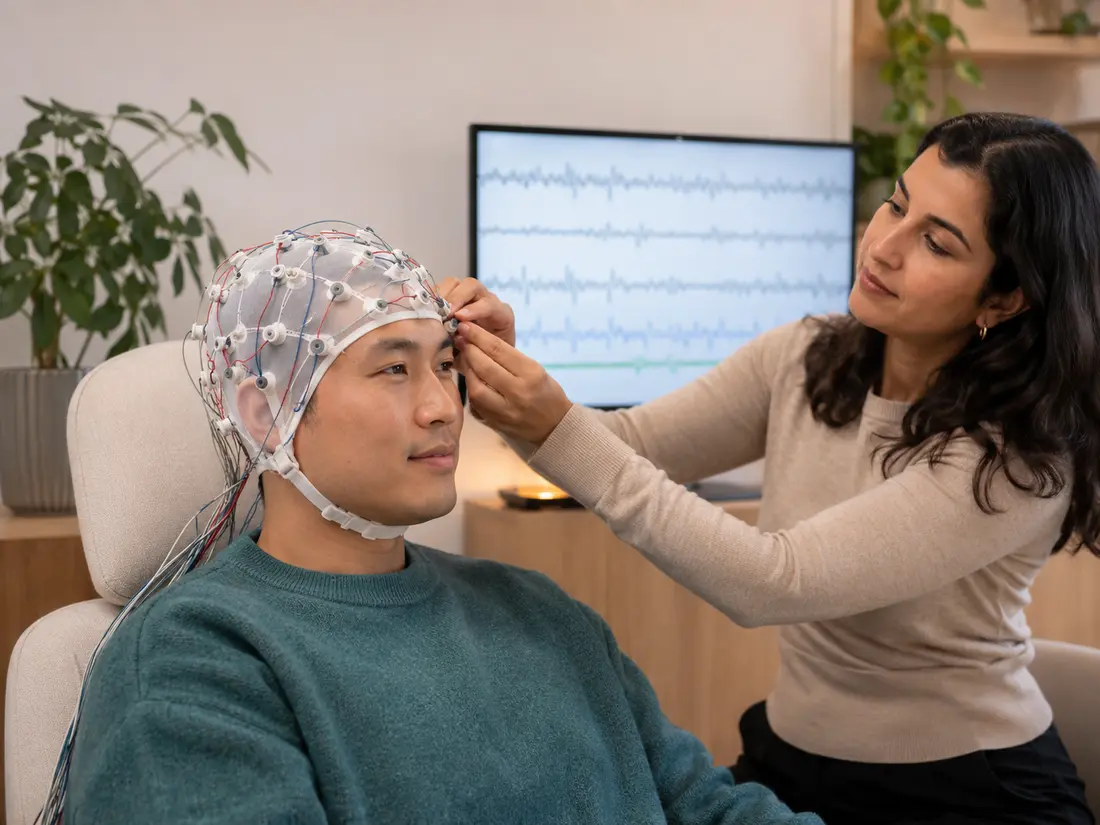
Since we are going to talk about EEG, it is worth clearing up what it measures, because the popular version has drifted a long way from the physiology.
An EEG sensor on the scalp does not read thoughts, and it does not read individual neurons. It picks up the summed electrical fields produced by the coordinated activity of large populations of neurons, mostly the synaptic currents in pyramidal cells lined up perpendicular to the cortical surface. What reaches the scalp is a smeared, distance attenuated average of millions of cells.
Which means the amplitude of a brain rhythm is mostly a measure of how many neurons are doing the same thing at the same time, not how hard the brain is working. A large alpha rhythm does not mean more activity. It means more synchrony.
This matters, because it undercuts a lot of what gets said about brain waves. Alpha is not a mood. Theta is not creativity. Beta is not stress. These bands are frequency ranges, and the same frequency in different regions, at different times, in different people, can mean quite different things. Treating them as personality traits is a bit like judging an orchestra by how loud it is.
What matters far more than amplitude is timing. Which populations are synchronizing with which. Whether they are in phase or out. How quickly they couple and uncouple. Whether slow rhythms are organizing the timing of faster ones, a phenomenon called cross frequency coupling that appears central to how the brain coordinates across scales.
The brain is not a set of dials. It is a timing system.
In plain language: EEG measures how synchronized populations of neurons are, not how active the brain is. Timing and coordination matter more than amplitude.
The edge between order and chaos
Now the interesting question. If billions of threshold units are wired together with excitation and inhibition, what dynamical regime should they operate in?
Dynamical systems theory gives us the right tool for this question: the control parameter. A control parameter is a quantity that, as it moves, changes not merely how much a system does but what kind of behaviour it is capable of at all. Temperature is the control parameter for water becoming ice. In cortex, the balance between excitation and inhibition is one of the leading candidates. Move it far enough and the network does not simply do more of the same thing. It reorganizes into a qualitatively different regime.
There are two obvious failure modes.
If coupling is too strong, activity spreads without limit. One region fires, its neighbours fire, their neighbours fire, and the whole network locks into a single global rhythm. Highly ordered, highly synchronized, and functionally useless, because a system where everything does the same thing cannot represent anything. The clinical version of over synchronization is a seizure.
If coupling is too weak, activity dies out locally. Each region does its own thing, nothing propagates, and there is no coordination to speak of. Highly disordered, and equally useless, because a system where nothing influences anything else cannot integrate information.
Between these lies a narrow regime where activity neither dies nor explodes, where a local event has some chance of propagating a long way but usually does not. In physics, this is the neighbourhood of a phase transition, a critical point.
In 2003, John Beggs and Dietmar Plenz recorded from cortical tissue and found something striking. Bursts of spontaneous activity, which they called neuronal avalanches, came in sizes that followed a power law distribution. Lots of tiny cascades, fewer medium ones, occasionally a large one, with no characteristic size, exactly the scale free signature described in part one. Power law distributions of event sizes are a hallmark of systems poised near criticality, and they have since been reported in cortical recordings across species and methods.
The appeal of the idea is what criticality would buy a brain. Near a critical point, theoretical and experimental work suggests a system has maximal dynamic range, meaning it can respond to both very weak and very strong inputs. It has maximal information transmission and storage capacity. It has the longest lasting correlations, meaning what happened a moment ago can still influence what happens now. And it is maximally sensitive to small, well timed perturbations, which is a sentence worth underlining and returning to in part three.
Now the honest part. The critical brain hypothesis is an active research programme, not settled science. Recent critical assessments, including work published in 2025 and 2026 asking whether criticality really functions as a unified setpoint of brain function, argue that some power law findings can arise from other causes, that the brain may sit near but not exactly at criticality, and that different regions and states may operate at different distances from it. This is a live scientific argument.
What is more robustly established, and what actually carries the weight in this series, is the broader claim: the brain operates in an intermediate regime between rigid order and disorder, that regime supports flexible information processing, and departures from it in either direction are associated with impaired function. You do not need criticality to be exactly right to take that seriously.
In plain language: cortical networks appear to sit in a narrow band between too much synchrony and too little, which is where flexible processing lives. How precisely they sit there is still being debated.
Metastability, or why the brain never settles
If part one gave you the marble and bowl image, here is where it needs upgrading.
A simple dynamical system rolls into an attractor and stays there, after which its trajectory becomes rather boring. The brain does not do this. It moves continuously through a sequence of transient, partly stable configurations, each one lasting a fraction of a second, none of them permanent. Scott Kelso called this metastability, and it is arguably the central concept for understanding a healthy nervous system.
The picture is of a landscape with many shallow valleys rather than one deep bowl. The system visits a valley, stays briefly, and moves on. It is pulled toward coordination but never fully captured by it, and pulled toward independence but never fully fragmented. Kelso’s phrase is that the parts are neither entirely coupled nor entirely uncoupled. They are in ongoing negotiation.
The dynamical systems term for this kind of wandering is itinerancy: a trajectory that lingers near one attractor, leaves before being captured, and moves on to the next, never converging. What might look like restlessness is the signature of a system that has kept its options open.
Walter Freeman found something similar decades ago recording from the olfactory bulb: patterns of activity that formed, held briefly, and dissolved as the animal sampled the world. Modern resting state imaging shows the same thing at whole brain scale, with the brain cycling through a repertoire of recurring network configurations even when the person is doing nothing at all.
Two properties of this repertoire seem to matter for health. How large it is, meaning how many distinct states the system can occupy. And how freely the system moves between them.
That is the technical definition of flexibility. And it gives us a precise way to say what we mean when we say a nervous system has lost range.
In plain language: healthy brains move continuously through many transient states rather than settling into one. Flexibility means having a wide repertoire and moving through it freely.
When a system gets stuck

Now the part that is not abstract.
Everyone has valleys in their landscape that are deeper than others. That is not pathology, it is learning. A pattern that has been used many times becomes easier to fall into, which is exactly what you want for riding a bicycle and exactly what you do not want for a 3am worry loop.
When people describe being stuck, they are usually describing a valley that has become deep enough that ordinary nudges cannot lift the system out of it. In dynamical terms, the attractor has deepened and its basin has widened, so more starting conditions lead into it and fewer trajectories find their way out.
Rumination is a system that keeps returning to the same configuration. Each pass makes the valley slightly deeper, which is why just stop thinking about it is not merely unhelpful advice but a category error, like telling water to stop flowing downhill.
Panic has a positive feedback loop at its centre. Sensation triggers alarm, alarm amplifies sensation. Once the loop engages it runs to completion, which is why panic feels less like an emotion and more like a process happening to you.
Hypervigilance after trauma is a system that has moved its threshold. The relevant valley is now entered by inputs that would not previously have entered it, and it takes a long time to leave. This is worth saying carefully: that shift was adaptive. A nervous system that learned to detect threat quickly in an environment where threat was real did its job. The difficulty is that the setting persists after the environment changes, and the person is left with a system exquisitely tuned for a world they no longer live in.
Shutdown and numbness are the other failure mode: not too reactive but too flat, a collapse in range where the system stops moving between states much at all.
Insomnia is often a transition problem rather than a state problem. Falling asleep is a phase transition, and in insomnia the system approaches the boundary and does not cross it.
What does the research say about all this? Carefully, and at group level. Reduced heart rate variability is consistently associated with anxiety and depression, which is the loss of complexity story from part one showing up in mental health. Studies of long range temporal correlations in EEG, the scale free structure we described earlier, report altered patterns in depression and other conditions. Work on brain dynamics in PTSD and anxiety points toward reduced flexibility in state transitions. The scoping review literature on brain criticality argues that a number of clinical conditions can be usefully described as departures from the healthy dynamic regime.
Two large caveats belong here and belong in any honest article on this subject. These are statistical differences between groups, not tests that can tell an individual anything. And describing an experience in systems language does not explain it away or reduce it to physics. What it offers is a different relationship to it.
That relationship is the reason this section exists. If being stuck is a property of a system’s dynamics rather than a defect of character, then several conclusions follow that people rarely arrive at on their own. It is not a willpower failure. Insight alone often will not shift it, which is why so many people can explain their pattern in detail while still living inside it. And the fact that a small change did nothing last month does not mean small changes do nothing, which brings us to the more hopeful half of the story.
In plain language: stuck patterns can be described as valleys that have become too deep to leave with ordinary effort. This is a description of dynamics, not a judgment of character.
How complex systems actually change
Nonlinear dynamical systems do not usually change gradually. They change at thresholds, when a control parameter crosses a critical value and the pattern the system has been holding loses its stability.
The cleanest demonstration in all of human neuroscience is also one of the simplest experiments ever run. Kelso asked people to wiggle their index fingers side to side in antiphase, one going out while the other comes in, in time with a metronome. Easy at slow speeds. As the metronome sped up, the antiphase pattern became harder to hold, and then at a certain frequency the fingers spontaneously flipped into moving together, in phase. Nobody decided to switch. The pattern became unstable and the system reorganized into a different one.
That is a phase transition, or in the mathematical vocabulary, a bifurcation. Water becoming ice. A gait shifting from walking to running at a particular speed rather than gradually blending. A quiet conversation tipping into an argument. The system does not slide from one behaviour to another; it holds, then jumps.
Three consequences follow, and they are the core of what this series is building toward.
First, position matters more than force. A system far from any threshold can absorb an enormous input and barely move. A system near a threshold can be moved by a very small one. This is why the same intervention lands completely differently at different moments, and why timing in therapy is not a soft skill but a structural fact about nonlinear dynamical systems.
Second, noise can help. There is a genuinely counterintuitive phenomenon called stochastic resonance in which adding a small amount of random noise to a nonlinear system improves its ability to detect weak signals. Below threshold signals that would never trigger a response get pushed across by the noise. It has been demonstrated in sensory neurons, and applied in a memorable study where older adults with impaired balance stood on insoles that vibrated at levels below conscious perception, and their sway measurably improved. Adding a little noise made the system more sensitive, not less. A perfectly clean, perfectly regular input is not always the most informative one.
Third, disturbance can be constructive. In systems built from oscillators, a well timed pulse can reset the phase of the rhythm, shifting the timing of everything downstream. EEG research has looked at phase reset as a mechanism the brain itself uses to coordinate and to mark salient events. A brief, well placed interruption is not damage to a rhythmic system. It is information.
Put those three together and you have a general principle worth carrying out of this article: complex systems reorganize in response to accurate, well timed information, delivered when the system is near a transition, and not necessarily in response to force.
In plain language: systems change at thresholds, not by gradual pushing. Small, well timed inputs near a threshold do more than large ones at the wrong moment.
What this means for therapy, and where neurofeedback comes in

This is why the systems view is not just an interesting frame. It changes what counts as helpful.
If a nervous system reorganizes in response to new information delivered in the right conditions, then the various things that help people are all, in different ways, information delivery mechanisms.
Therapy provides relational information. In couples work and individual therapy alike, a good deal of what changes is the system’s expectation about what happens when it moves toward another person. EMDR therapy works with traumatic memory in a way that many clinicians describe as allowing the nervous system to process material it had held in an unprocessed state, which is a plausible description of a system that has been stuck in a valley being given the conditions to reorganize. Mindfulness based approaches train the capacity to notice a state without immediately being carried by it, which in this language is the capacity to observe your own trajectory in state space, an ability that makes transitions more available. Sleep, movement, breathing and connection change the parameters of the system itself, which is why they show up in every treatment plan and why they are not filler.
Anxiety counselling, therapy for PTSD and complex trauma therapy each work with different parts of this picture, and which one fits depends far more on a person’s history and goals than on any of the physics described above.
Neurofeedback enters this list at a specific point. It is the one approach that gives the system information about its own electrical activity, in close to real time, on a timescale far faster than conscious awareness.
There is a peer reviewed framework for thinking about this. Tomas Ros and colleagues have argued that neurofeedback can be understood through self organized criticality: that the training perturbs the brain’s ongoing dynamics, and that what changes is not a single frequency band but the system’s position within its dynamical regime. Their later work reported that a single neurofeedback session was associated with measurable shifts in the scale free structure of spontaneous brain activity. That is a modest finding in a small literature, and it is not evidence that any particular device helps any particular condition. But it is the right kind of finding, because it is measuring the thing this whole article says is important: not the level of a band, but the character of the dynamics.
Which sets up the final article. If a brain is a self organizing dynamical system near a transition, maximally sensitive to well timed information about itself, then a system that detects the moments when its electrical activity shifts abruptly, and marks those moments with a brief interruption in a piece of audio, is doing something quite specific. NeurOptimal sessions are built on exactly that premise.
Part three describes what actually happens in one, what the evidence does and does not support, and why change from this kind of work tends to arrive unevenly rather than on schedule.
Glossary additions for this article
Dynamical regime: the qualitative kind of behaviour a system is currently capable of, as distinct from the particular values it happens to be showing.
Control parameter: a quantity that, as it changes, moves a system from one dynamical regime into another. Excitation and inhibition balance is one candidate in cortex.
Basin of attraction: the set of starting conditions from which trajectories lead into a given attractor. A widened basin is one way of describing a pattern that has become easy to fall into.
Itinerancy: a trajectory that visits a succession of transient attractors without settling into any of them.
Action potential: the all or nothing electrical spike a neuron produces once its membrane potential crosses threshold.
Synchrony: the degree to which populations of neurons are active at the same time. EEG amplitude largely reflects this.
Criticality: the state of a system poised near a phase transition, associated with maximal dynamic range and sensitivity to input.
Neuronal avalanche: a cascade of activity through a neural network. The distribution of avalanche sizes is one of the main pieces of evidence cited for brain criticality.
Metastability: the property of moving continuously through transient, partly stable states rather than settling into one.
Bifurcation: a point at which a small change in a parameter causes a system to switch abruptly into qualitatively different behaviour.
Stochastic resonance: the phenomenon whereby adding a small amount of noise improves a nonlinear system’s ability to detect weak signals.
Phase reset: a shift in the timing of an ongoing rhythm caused by a well timed input.
Frequently asked questions
Is the critical brain hypothesis accepted science?
It is an active and productive research programme rather than settled fact. The core observations, including power law distributed neuronal avalanches, have been replicated across species and recording methods, but recent critical assessments published in 2025 and 2026 have questioned whether criticality functions as a single setpoint for brain function, whether some power law findings have other explanations, and how close to criticality the brain actually sits. The broader and better established claim is that the brain operates in an intermediate regime between excessive order and disorder.
What does it mean to study the brain as a dynamical system?
It means treating the brain as something defined by how its state changes over time rather than by fixed quantities. Instead of asking how much activity there is in a region, the questions become what trajectory the system is on, which dynamical regime it is operating in, how stable that regime is, and what would move it into a different one. That is why measures of timing, variability and transitions run through this whole article, and why a single number from a scan or a recording rarely captures what matters.
Does this mean anxiety is a brain problem rather than a psychological one?
No, and that split is part of what the systems view dissolves. Describing anxiety in terms of dynamics is a different level of description, not a competing explanation. Meaning, memory, relationships and circumstance are what shape those dynamics in the first place. Nobody’s nervous system became hypervigilant for no reason.
Can an EEG tell me whether my brain is stuck?
Not in any clinically meaningful individual sense. The research described here reports statistical differences between groups, often small, using analysis methods that are not diagnostic tests. Assessment tools can be useful for guiding certain kinds of training, but be cautious about any claim that a recording reveals what is wrong with you or predicts what will help.
If small changes matter, why has nothing I have tried worked?
Because position matters as much as size. A small input near a threshold can shift a system, while the same input far from one does almost nothing, and long standing patterns tend to sit in deep valleys. This is also why the same change can feel useless in one period and effective in another. It is genuinely not a measure of how hard you have tried.
Is neurofeedback based on this research?
Some approaches are explicitly framed this way. There is peer reviewed work proposing self organized criticality as a framework for understanding neurofeedback, and a study reporting that neurofeedback was associated with changes in the scale free structure of brain activity. It is important to keep two things separate: the science of nonlinear brain dynamics is substantial, while the evidence for any specific neurofeedback system is much more limited. Part three of this series addresses that directly.
Where to start
Part three looks at what a NeurOptimal session actually involves and what the evidence does and does not support. You can also read more about neurofeedback as a support for anxiety.
If any of this describes something you are living with, you do not need a background in systems science to get support with it. View therapist profiles, approaches and availability, and book online through JaneApp. If you are not sure who to start with, contact us and we can help you find a good fit.


